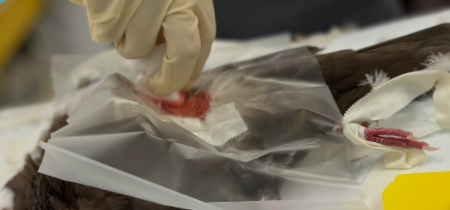
Thirty pigeons were anesthetized and prepared
for both right and left lateral approaches
to coeliotomy. Feathers were plucked, and
skin swabs for colony-forming unit (CFU)
determination were obtained before and after
application of each of five antiseptic protocols:
chlorhexidine 4% and povidone iodine 7.5%
each with a saline or alcohol rinse, DuraPrep
without a rinse, and saline used for both scrub
and rinse as the control. CFUs were counted
after 48 hours of incubation. Core body
temperature was measured via esophageal
probe during preparation of the first site for
each bird. Seven of the post-treatment swabs
grew bacteria, five were selected for MALDI-
TOF identification and Staphylococcus spp.
were isolated from all five swabs. All antiseptic
protocols significantly reduced bacterial load,
with no significant difference in effectiveness
between protocols when excluding the
saline control. One-way ANOVA revealed no
significant differences in temperature changes
across treatments. These findings indicate
all tested protocols containing an antiseptic
were effective at reducing bacterial load
without significant variation in effectiveness.
Additionally, there were no statistically
or clinically significant changes in body
temperature regardless of treatment.